
当前课程知识点:大学计算机基础 > 第6章 计算机网络环境 > 6.2 局域网技术 > 6.2.2扩展阅读——无线局域网
6.2.2 扩展阅读:无线局域网.docx---点此下载文件
1. 无线局域网的定义
无线局域网(Wireless Local Area Network,WLAN)是一种不采用传统电缆线的同时,提供传统有线局域网的所有功能的无线网络。无线局域网只是有线局域网的扩展和替换。他只是在有线局域网的基础上通过无线路由器、无线网卡等设备是无线通信得以实现。同时,采用红外线或无线电波作为传输介质。无线局域网中的所有组件都需要通过Wi-Fi组织进行认证,所以无线局域网又称Wi-Fi网络。
2. IEEE 802.11无线网络协议
802.11协议组是国际电工电子工程学会(IEEE)为无线局域网络制定的标准。
(1)IEEE 802.11b 协议
IEEE 802.11b 协议是由IEEE于1999年9月批准的,该协议的无线局域网工作在2.4GHz频段,带宽最高可达11Mbps,也可根据实际情况自动切换到5.5Mbps、2 Mbps和1 Mbps,理论上在室内的最大传输距离为100m,室外可以达到300m。
(2)IEEE 802.11a 协议
IEEE 802.11a标准是已在办公室、家庭、宾馆、机场等众多场合得到广泛应用的802.11b无线联网标准的后续标准,同样是在1999年制定完成的。它工作在5GHz频段,最大传输速率可达54Mbps,传输距离在100m到300m。
(3)IEEE 802.11g 协议
IEEE 802.11g 协议于2003年6月正式推出,是在802.11b协议基础上改进的协议,工作在2.4GHz频段,最大传输速率为54Mbps,能够与IEEE802.11b的系统互联互通。
(4)IEEE 802.11n 协议
IEEE 802.11n 协议于2009年9月通过正式标准,它将WLAN的传输速率由目前802.11a及802.11g提供的54Mbps、108Mbps,提高到350Mbps甚至高达475Mbps。
3. 无线局域网的构建
(1)有固定基础设施的WLAN
有固定基础设施的WLAN是指利用预先建立起来的、能够覆盖一定地理范围的一批固定基站(称为接入点,AP)实现无线数据通信。无线站点通过AP进行通信,如图6-25(a)所示。
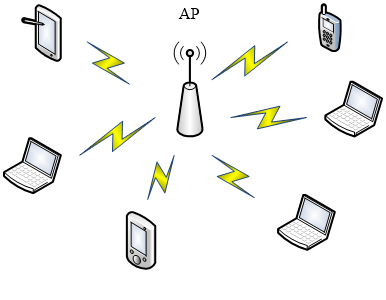
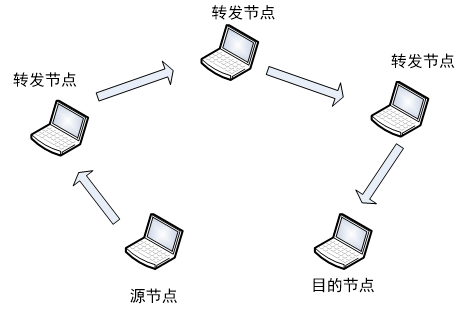
(a)有固定基础设施的WLAN (b)无固定基础设施的WLAN
图6-26 WLAN
(2)无固定设施的WLAN
无固定基础设施的WLAN称为自组织网络,又称Ad-hoc网络。这种网络没有AP,是由一些处于平等状态的移动工作站之间相互通信组成的临时网络,如图6-25(b)所示。
-开篇导读
-常见问题
-1.1 计算文化
--1.1.1 Computer history and development Part I
--1.1.2 Computer history and development Part II
--1.1.3 Application of computers and computational thinking
-1.2 计算思维
--1.2.3扩展阅读——Computational Thinking
--1.2.1 the nature of computational thinking
--1.2.2 Problem solving using computational thinking
-第1章作业
-2.1 数制
--2.1.1 0
-2.2 0/1世界中的数值
--2.4 Binary arithmetic and logical operations
--2.5 Signed and unsigned numbers
--2.6 sign-magnitude,one's complement,two's comliement representation and real munber
-2.3 0/1世界中的字符
--2.7 Characters in digital world
-2.4 0/1世界中的图片、声音和视频
--2.8 Images, sounds and videos in digital world
-2.5 条形码
-第2章作业
-3.1 算法概述
--3.2 Description of algorithms
-3.2 典型算法
--3.3 Typical algorithms enumeration and induction
--3.4 Typical algorithms recursion and iteration
--3.5 Typical algorithms divide-and-conquer and backtracking
-3.3 Python语言编程基础
--3.3.2 Python基础语法及编程示例1-基本语法、条件语句
--3.3.3 Python基础语法及编程示例2-循环语句、内置函数
--3.3.4 Python基础语法及编程示例3-自定义函数
--3.3.1 Introduction to Python
--3.3.2 Python I basic syntax and conditional statements
--3.3.3 Python II loop statements and built-in functions
--3.3.4 Python III user-defined functions
--3.3.5 Python IV drawing with turtle
-第3章作业
-4.1 计算机的硬件系统
--4.1.2 Von Neumann architecture and computer organization
-4.2 计算机的基本工作原理
--4.2.1 Basic working principles of computers
-4.3 现代微机构成及性能指标
--4.3.1 Composition and performance of modern computers
-第4章作业
-5.1 计算机软件概述
--5.1 Overview of computer software
-5.2 系统软件
--5.2.1 System software I_operating system
--5.2.2 System software II programming language, compiler and DBMS
-5.3 应用软件
-第5章作业
-6.1 计算机网络平台
--6.1.5扩展阅读(2)——OSI参考模型与TCPIP的比较
-6.2 局域网技术
-6.3 Internet及其应用
--6.3.1 IP address and domain name
--6.3.2 Access and application of the Internet
-6.4 网络安全
-第6章作业
-7.1 数据管理
--7.1.1 Data managment and data models
-7.2 结构化数据库
--7.2.2 Creating a local database
--7.2.4 Data definition language
--7.2.5,7.2.6 Data Query Command
--7.2.7 Data manipulation language
-7.3 大数据
-第7章作业
-8.1 人工智能
--8.1.2 Artificial intelligence
-8.2 物联网
-8.3 云计算
-8.4 区块链
--【讨论帖】央行DCEP vs Facebook Libra:数字货币你了解多少?
-第8章作业
-9.1 Windows基本操作
-9.2 Windows程序管理
-9.3 Windows文件管理
-9.4 Windows设备管理
-第9章作业
-10.1 Word基本操作
-10.2 论文排版
--论文排版素材
-10.3 修订文档
-第10章作业
-11.1 Excel基本操作
-11.2 公式和函数
-11.3 数据分析和处理
-11.4 数据可视化
-第11章作业
-12.1 PowerPoint基本操作
-12.2 论文展板制作
-第12章作业